April is definitely a busy month. What with taxes, Easter, spring break, Script Frenzy, and watching for daffodils (because then I know spring has finally arrived) there is a lot to do. Somehow I get around to celebrating poetry by gathering together various poem activities and presenting them to my students. And I try to get a couple of new poems flowing out of the winter attic.
As for NPM there is a lot of ground to cover. Got a question? Here are some answers:
Also, here are some really fun poetry videos to celebrate the diversity of poetry:
Adorable kid who loves poetry, reciting Billy Collins “Litany. I’m inspired to memorize.
And if you want the real deal–here’s Billy Collins, himself. I love how he pokes fun at the perceived seriousness of poetry. I think he and Billy Shakespeare would have had a great friendship.
If you haven’t ever experienced Taylor Mali‘s poetry I hope you will be as enthralled with his tribute to teachers (because he is one) as I am:
Artsyarchitette brightened my day with The Versatile Blogger Award. Being fairly new to blogging, I naturally am amazed to even be noticed among the thousands of bloggers out there, and then again secretly I’m basking in the glory of the moment because I really work hard at making each post special.
So here is the award:
And here is my 7 facts:
1. dark chocolate
2. Mozart preferably
3. Summer, not winter
4. GiGi
5. DVD, unless there’s a strict no phones policy
6. Audrey Hepburn
7. Naps
As to the 15 bloggers. Mmm, fudgeitfudgy, here’s 5 for now:
In researching the award I have discovered there is definitely a split opinion roaming around. Some say they are just a chain letter of sorts, and others say celebrate and pass on the love. I’m a bit in the middle. I’ve done most of the award requirements, and hope the award police won’t yank it off my site since I’ve only 5 instead of 15 nominates.
What is your opinion of these awards?
Are they:
A. lovely bits of affirmation
b. meaningless
c. more work than glory
d. somewhere in between
Anyway, I’m pleased and happy and more than willing to pass on the love
Blue Skies,
CricketMuse
P.S. This marked my 30th posting–is there a connection? Do I get an iPad with my 50th?
The Ides of March have come and gone and so as the unit on Julius Caesar. Between Odysseus, Hamlet, and the Roman senate I feel I have been wading in testosterone for a month. Lots of wanderlust, stabbings, and confused emotions of doing the right thing. Next month it’s satire, heroes, and star-crossed lovers, which should provide a decent change up of scenery.
I learned my lesson about front loading Caesar a few years ago when I first started teaching the play to sophomores. I thought my students knew all about Julius Caesar. Wrong, so wrong. Roman history is not a featured item in most history books up to ninth grade, and it’s not much of a feature in high school at all–that is, unless students opt for World History as one of their electives, and even then not a lot of time is part on the Roman Empire. This is why there wasn’t much impact when the protagonist is bumped off by the second act. Why should my students care about the hero dying when they hardly know him?
Speed it up a few years, interject some marketing savvy, and Julius Caesar becomes a dynamic unit. My recipe for getting kids to care about Gaius Julius Caesar.
1. Show a Hollywood version of Caesar that is colorful, even though historical correct: baiting the hook
Jeremy Sisto plays a likable Caesar. I play the movie up to the point of where Caesar returns to Rome after Gaul, receiving the cheers of the Romans and the news that Pompey has fled, fearing for his life. This builds up intrigue and my students better understand what is going on when we began reading the play.
2. Fishing for interest: Assign parts, upping the reluctance with bonus reading points.
After writing the parts on the whiteboard I stand back and let my students sign up for who they want to read. Equal voice prevails in that it’s okay for guys to read female parts and vice versa. I’ve had some lovely deep-voiced Portias, and some commanding lighter-toned Cassius readers. Shakespeare would understand the need to pinch-hit.
3. We read up to the assassination. I used to include it as part of the agenda, yet my wanna be thespians somehow couldn’t do the death scene with proper dignity. I decided to give that over to the more experienced. There are a number of productions to choose from, although I keep with the tried and true John Gielgud version.
4. After each act we have class discussions about themes, issues, and notables. This is my favorite part, getting students to realize how history has shaped the world they live in. Events of a thousand years ago still echo down the corridors of their everyday life. We discuss ideas such as: Is murder ever valid? Do political leaders always act in the best interests of their country? Are beliefs worth dying for? These fifteen year old minds begin grasping the need to be informed and how being informed influences the vote they will cast in three years.
5. Once the play is packed up, the packet turned in, I reel in my students as we move on to the really fun stuff: Who was Caesar? I want my students to understand his far-reaching influence (beyond calendars, salads, and quippy quotes) and get to know the man and form their own opinion about him. I know Shakespeare had his reasons for not including Cleopatra in the play; however, Cleo cannot be ignored. So she gets showcased because she was a larger-than-life influence on Caesar:
I annoy my students with all kinds of move trivia: costs (1 million to Liz–a shocking amount; 44 million to make–equaling about 300 million today); tracheotomy scars (Liz almost died, you know); thousands of extras (pinch police to protect the ladies); real sets (CGI in ’63?). Grand stuff, indeed.
I also slip in a documentary with the idea that Hollywood and history don’t always see eye to eye on the truth.
The Sparknotes folk have done a really new cool thing by creating learning videos. This one was also helpful:
Then the assignment: Write an opinion essay on who you believe Caesar to be? Was he a megalomaniac who murdered for his own means? A philandering player who used women as stepping-stones to increased power? A frustrated tyrant? A genius strategist? A leader cut short in his prime? I guess the term is officially called synthesizing–gathering all the evidence and sifting it to form a valid opinion. Kind of like suffering through election year.
The play itself is not one of my favorites: “Hey, I’ll stab you, you stab me, will all die so nobly.” A little too gritty for my tastes. I do find a fascination in Caesar and I look forward to reading those essays.
In our district it’s mandated we have our objectives up on the board so that all may see what it is we are trying to get our students to learn. Mine for the Julius Caesar unit?
May my students learn from the experiences of the past in order to better apply the knowledge that is gained
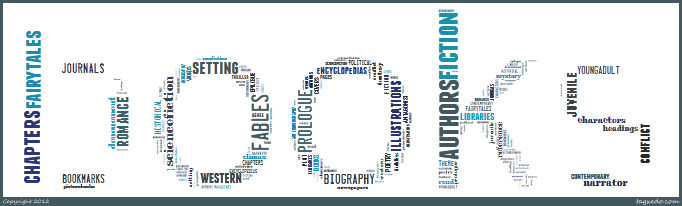
I love wordplay almost as much as I love playing with words. I came across this site Tagxedo and I’m starting to take words created, mine and other inspirations, and create word art. Here is a very basic one promoting my Book Boosters campaign (you have signed up, haven’t you?) I simply wanted to express how books add color into our life, and how much I love books. There is more than one way to present your “words, words, words” to the world. Ooh, that gives me an idea…
Okay, it’s not perfect. I know. It was fun thinking up how many words I could connect with books.
I hope you check out the site and get your word play on.

 April is definitely a busy month. What with taxes, Easter, spring break, Script Frenzy, and watching for daffodils (because then I know spring has finally arrived) there is a lot to do. Somehow I get around to celebrating poetry by gathering together various poem activities and presenting them to my students. And I try to get a couple of new poems flowing out of the winter attic.


 Jeremy Sisto plays a likable Caesar. I play the movie up to the point of where Caesar returns to Rome after Gaul, receiving the cheers of the Romans and the news that Pompey has fled, fearing for his life. This builds up intrigue and my students better understand what is going on when we began reading the play.




 Pam Webb