Pam Webb

a writer's journey as a reader

Archive for the category “creativity”

Forming Poetry: Parodies


Helvetica cattle

Helvetica cattle (Photo credit: Wikipedia)


Parody Poems


“Imitation is the best form of compliment” or so they say.  A Parody Poem emulates or copies a known style of poet.  Special attention is paid to tone, diction, rhythm, meter—basically getting the poet’s style so that it is recognizable.


Here are some parody poems using the famous “Purple Cow” poem:


 A Purple Cow


By Mr. Gelett Burgess
I never saw a Purple Cow,
I never hope to see one;
But I can tell you, anyhow,
I’d rather see than be one.


And here are the parodies:


Edgar Allen Poe


Parody by Susan and David Hollander
One lonely, gloomy, windswept eve
A mournful sound did I perceive.
I cast my eyes beyond the pane
And to my horror down the lane
Came a sight; I froze inside
A spectral cow with purple hide.

Emily Dickinson
Parody by Susan and David Hollander
On far off hills
And distant rills,
Sounds a distant moo.
A purple spot
I think I caught,
Yes! I see it, too!

In Bovine majesty she stands,
Her purple tail she swings,
The amethyst cow,
To my heart somehow,
Perfect joy she brings.

And yet the thought of being
Of that race of royal hue,
Though glowing like the violet sweet,
It really would not do.

William Wordsworth
Parody by Carolyn Wells
She dwelt among the untrodden ways
Beside the springs of Dee;
A Cow whom there were few to praise
And very few to see.

A violet by a mossy stone
Greeting the smiling East
Is not so purple, I must own,
As that erratic beast.

She lived unknown, that Cow, and so
I never chanced to see;
But if I had to be one, oh,
The difference to me!

Rudyard Kipling

Parody by Carolyn Wells*
In the old ten-acre pasture,
Lookin’ eastward toward a tree,
There’s a Purple Cow a-settin’
And I know she thinks of me.
For the wind is in the gum-tree,
And the hay is in the mow,
And the cow-bells are a-calling
“Come and see a Purple Cow!”

But I am not going now,
Not at present, anyhow,
For I am not fond of purple, and
I can’t abide a cow;
No, I shall not go today,
Where the Purple Cattle play.
But I think I’d rather see one
Than to be one, anyhow.

Challenge alert:

Do any of you feel the pull of purple cow within your poetry muse?


Shaping Up Poetry: Metaphor Thirds


joyous heart

joyous heart (Photo credit: Leonard John Matthews)


I’ve made this a part of our sophomore poetry curriculum and I am always taken by surprise at the superlative poems students produce with this format.  I found this form in  the book Risking Intensity by Judith Rowe Michaels.

Metaphor Thirds

1. Fold a piece of paper into vertical thirds

2. In the first third write five emotions, then fold back the paper

3. In the second column write five colors—these can be basic ones like red, blue, yellow or a bit more imaginative like periwinkle, chartreuse, silver-gray—then fold over this section

4. In the last column write objects or animals

5. Open out all the sections and read directly across

anger                    red                            door

sad                        periwinkle              mirror

 joyful                  chartreuse              star

loneliness         indigo                       blanket

nervous             brown                      rabbit

6. Read each line across to make five metaphorical statements. For example: Anger is a red door, sad is like a periwinkle mirror, joyful as a chartreuse star, loneliness is like an indigo blanket, nervous like a brown rabbit

7. Choose a metaphor statement and begin to think about the feeling, the color, and the object. What associations come to mind? Brainstorm some of what comes to mind with the image.

8. Begin to work the metaphor statement into a poem, either placing the statement as it is written or work the image into a conceptual piece. The metaphor thirds poem actually works best in a free verse form, although internal rhyme works well.

Chartreuse Leaf

Chartreuse Leaf (Photo credit: teresia)

multicolored splendor
that’s just how my day
has been
confetti bits of happiness
round about me
dancing
bright lights
of promise
like spring after
a tedious winter
A happy day filled
with greens, and light

Joyous like a chartreuse star

-(first draft of the poem found on the Triptych of Daffodils post)

Shaping Up Poetry: Object Poem


Object Poem

1.  Select an object
2.  Explore it using the following questions:
What does it look like?
How or why does it look like that?
What colors do you see?
What do the colors remind you of?
What does it smell like?
What does it feel like?

3.  Here is a guide to help structure your Poem:
First it is….
And then it is like…
And now it becomes…
and now it is…
And now it is…
And now I am …

Here is an excerpt from Gift from the Sea by Anne Morrow Lindbergh.  Listen for the comparisons and descriptions based on the poem guide.

This snail shell, round, full and glossy as a horse chestnut.  Comfortable and compact, it sits curled up like a cat in the hollow of my hand.  Milky and opaque, it has the pinkish bloom of the sky on a summer evening, ripening to rain.  On its smooth symmetrical face is penciled with precision a perfect spiral, winding inward to the pinpoint center of the shell, the tiny dark core of the apex, the pupil of the eye.  It scares me, this mysterious single eye–and I stare back.

Find an object and explore it through imagery, seeing it for what it is through expanding vision.

Shaping Up Poetry: Found Poems


Found Poetry is another one of those amazing forms that tweak our known ideas of what poetry should look like or what it should be. So, today let’s look at finding poetry in unexpected places.

What is Found Poetry? (thanks Wikianswers)

A found poem is one in which words and phrases are taken from various sources and then strung together to make sense.

It is named because the elements which compose the poem are “found”. The words or phrases “found”, although they were written in totally different contexts and not meant to be used together, all have some kind of common theme. When placed together, they make a poem that makes sense.

Directions:

1. Grab any prose source (newspaper or magazine articles, ad flyers, instructions, directions, even textbook passages) and select a passage of 100 words or less.

2. Go through and find words and short phrases that have a “poetical” sound or are unusual or simply seem unique or interesting.

3.  If possible cut these out from the source, and if this is not feasible (some schools and libraries are picky about cutting up their books and magazines) write them down.

4.  Collect about 50 words and set them aside (roughly “find” about half of the original count 100=50).

5. Begin moving them around until the poem finds its way on the page.  One idea is to create the basic idea of the original piece. Found Poems can be typed out or formed into a collage.

Of course, these are basic guidelines and there is lots of flexibility to finding your own poem.  Here are a few examples demonstrating the creativity of this form:

First of all, go to Poets.orgto read a “legit” Found Poem.

Now, for some collage styles:


This is an example of  blocking out the words in the source (be source it’s okay to do so!):

One other example is taking prose, in this case an excerpt of a short story,  and finding a poem within it: (my rendered interpretation)

From “the Osage Orange Tree” by William Stafford
On that first day of high school in the prairie town where the tree was, I stood in the sun by the flagpole and watched, but pretended not watch, the others.  They stood in groups and talked and knew each other, and standing near the corner looking everywhere but at the crowd.

First Day
She stood lonely
as the tree
in the school courtyard.
Everyone busily
moving
and
greeting
one another
bridging summer into fall.

She stood alone,
like the tree.
I saw her.
She didn’t see me.
As you can read I didn’t follow my own directions of cutting the words down to half.  That’s the loveliest aspect of poetry–it’s aching to have its own rules broken.

Hoping you will find your own poetry in whatever prose you come across.  Finding a poem hiding within the everyday stuff words are made up of is a bonus.

Happy Poetry Month!

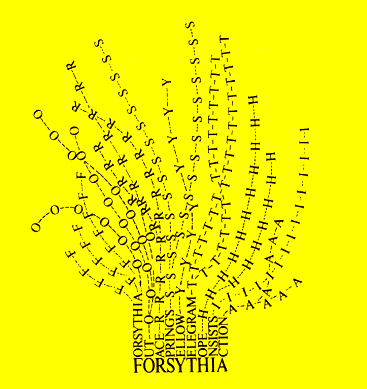
Shaping Up Poetry: Concrete Poems


One thing I truly enjoy about poetry is its diversity when it comes to form.  This week I’ll be featuring a variety of poem forms.  First up is concrete poetry.  Take it away Wikipedia:

George Herbert‘s “Easter Wings”, printed in 1633 on two facing pages (one stanza per page), sideways, so that the lines would call to mind birds flying up with outstretched wings.

Concrete poetry or shape poetry is poetry in which the typographical arrangement of words is as important in conveying the intended effect as the conventional elements of the poem, such as meaning of words, rhythm, rhyme and so on.

It is sometimes referred to as visual poetry, a term that has evolved to have distinct meaning of its own, but which shares the distinction of being poetry in which the visual elements are as important as the text.

Now that the definition is out of the way here are some examples.  Enjoy!

My students adore this form due to its playful nature, and I can often coax a poem out of them through shaping the words.  I encourage you to experiment or at least to look up more examples.

Happy Poetry Month!

Spoken Poetry


Poetry is an...

Poetry is an… (Photo credit: liber(the poet);)

Have you ever attended a Poetry Slam?  This  is where poetry gets to break out of its stuffy stereotypical silently read and reflected mode.  A Poetry Slam is where poets perform their poetry.  Recitation is accompanied by dramatics and the audience gets in on the action through rating the performance.  It’s amazing.  It will forever change your opinion that poetry can only be recited in dull monotones from a podium in front of barely stirring, half-asleep listeners.

One of my favorite Spoken Poetry artists is Taylor Mali. Not only was he formerly a teacher, he is one of the few poets who is actually making a living as a poet.  Go to his website or type in his name on YouTube for any number of his videos.  Much of his poetry deals with his experiences, opinions, and outlook as a teacher.  I can definitely relate to the subject matter–yet, his words reach to a wider audience as well.

His most repeated poem is:

http://www.youtube.com/watch?v=fuBmSbiVXo0

We held a poetry slam at our local library a few years ago.  One of my students performed her work and left the audience, mainly middle-schoolers with a smattering of high schoolers, cheering and clapping.  She was supposed to go on the regionals and couldn’t due to her age (16). Who would have thought talent could be hemmed in by being too young?

Check out Poetry Slams and next time someone says poetry is boring you can plug in a Taylor Mali and then ask for their revised opinion.

Happy Poetry Month!

A Triptych of Daffodils


The Poem

The Daffodils (I Wandered Lonely As A Cloud)

by William Wordsworth

Portrait of William Wordsworth, by William Shu...

Portrait of William Wordsworth, by William Shuter, 1798. (Photo credit: Wikipedia)

I wandered lonely as a cloud
That floats on high o’er vales and hills,
When all at once I saw a crowd,
A host, of golden daffodils;
Beside the lake, beneath the trees,
Fluttering and dancing in the breeze.

Continuous as the stars that shine
And twinkle on the Milky Way,
They stretched in never-ending line
Along the margin of a bay:
Ten thousand saw I at a glance,
Tossing their heads in sprightly dance.
The waves beside them danced, but they
Out-did the sparkling waves in glee:
A Poet could not but be gay,
In such a jocund company:
I gazed—and gazed—but little thought
What wealth the show to me had brought:

For oft, when on my couch I lie
In vacant or in pensive mood,
They flash upon that inward eye
Which is the bliss of solitude;
And then my heart with pleasure fills,
And dances with the daffodils.

The Parody

http://www.youtube.com/watch?v=cv1L-8f2erg


The Possibility*

       JOY

Multicolored splendor
that’s just how my day has been
Confetti bits of happiness
round about me swirling
filled with
Dancing Bright Lights
of promise
Like spring after
a tedious winter–
a golden day filled
with pristine greens
The release of dark days
and the renewing
of earth’s
bounty
Liberating–
like the  spangle sparkle
of firecracker flickers punctuating
the night sky
Free–
grass blades shimmer emerald
tree leaves bud pink
robin song chuckle eloquent
Bright light points of promise
that dance out from the earth
tingling and jingling
into
smile
eyes
all in reach
catch that feeling
of delicious buoyant
bounce of new
and they, too
will become
Joyous like a chartreuse star
Confetti

Confetti (Photo credit: DuracellDirect)

*from the collection The Dance of Color (an exploration of synesthesia)

Imagery of Poetry


Poetry and imagery are synonymous. For fun I pulled a variety of images that celebrate National Poetry Month.

poetry

http://cabell.lib.wv.us/pages/bb-poetry09.html

Visit www.poets.ca to find out more about the League of Canadian Poets and National Poetry Month

http://lcpnationalpoetrymonth2013.wordpress.com/

From Poets.org poster gallery:

2012 Poster, designed by Chin-Yee Lai    2008 Poster  2006 Poster   2005 Poster

2004 Poster

2002 Poster                           2001 Poster

1998 Poster

1996 Poster   1997 Poster

I ordered my poster for this year, did you?

Oh, the Magnetism of Poetry


Sometimes I lament that our library moved from its dilapidated and inadequate former bank building because it contained some quirky and cool things. For instance, part of the children’s section was located in the old vault–no kidding. Another interesting aspect to the building were the support beams and posts placed hither and thither, which made for shelving dilemmas. The posts placed so right there in the middle of everything begged for decoration.  One clever use of post availability were cookie sheets of word magnets.  Great fun in creating poems and stories by sliding and arranging these words about.

I created my own set of word magnets by cutting out words from magazine ads and gluing them on to strip magnets found in craft stores.  The progeny and their friends reveled in creating messages.  I’m tempted to do something along the lines with my students, yet I harbor concerns of inappropriate arrangements no matter how urbane the word selection might be.

For fun I found a site that provides the pleasure of refrigerator verse arrangements:

Refrigerator Poetry Play

Here is some inspiration in the mean time:

Image: tumblr.com

Coming to Terms with Poetry


education

education (Photo credit: Sean MacEntee)

They say the best education we receive is that learned while teaching.  I found this to be especially true for poetry fundamentals.

I don’t recall studying poetry in jr. high English, unless studying Simon and Garfunkel’s “Sounds of Silence” counts.  As for high school, I remember short stories, yet nothing on the poetry radar comes up for remembrance. College yes, ohmagoodness, poetry aplenty. I do recall a cacophony of emotions as I partook in the banquet of poets found in my Norton Reader. I transversed from embarrassment to  gratitude as I feasted on William Carlos Williams, Ezra Pound, Sylvia Plath and others I had not known existed.  Why, oh why, did I feel the compunction to resell my Norton at the campus bookstore?  College students out there?  Think twice before reselling your textbooks.  All those annotations and well-visited markings really do become appreciated some day.

norton reader

norton reader (Photo credit: cdrummbks)

These days I’m teaching to Common Core Standards and have come to terms with poetry.  They are an absolute on the schedule of attained knowledge.  I also have my AP crowd to cater.  Although I have over 200 literary terms we learn over the course of  the year in AP, I start out my ninth graders with double dozen or so.  How many do you know or remember?

  1. accent: emphasis or stress given a syllable or a particular word.
  2. alliteration: the reiterated initial consonants in prose or poetry.
  3. anaphora: repetition of an opening word or phrase in a series of lines.
  4. assonance:  the repetition of two or more vowel sounds in successive words, creating a type of rhyme.
  5. ballad: a song which tells a story; also be a poem with songlike qualities which tells a story.
  6. blank verse: the most common meter of unrhymed poetry in English; it lacks stanza form and rhyme.
  7. caesura: a pause within the line of verse.
  8. conceit: a fanciful expression, usually in the form of an extended metaphor or an analogy that usually displays intellectual cleverness due to the unusual comparison being made.
  9. consonance: a close similarity between consonants or groups of consonants, especially at the ends of words, e.g. between “strong” and “ring.”
  10. couplet: two consecutive lines of poetry that rhyme, and often have the same meter
  11. diction: the selection of words in a particular literary work, or the language appropriate for a particular (usually poetic) work.
  12. doggerel: crude verse that contains clichés, predictable rhyme, and inept meter and rhythm.
  13. elegy: a poem which mourns the death of someone.
  14. enjambment: when one verse runs into another verse
  15. epic: a long narrative poem on a serious subject, usually centered on a heroic or supernatural person.
  16. epigram: a short poem, which can be comical.
  17. figurative language: language which goes beyond what is denoted (see denotation), and has a suggestive effect on the reader; a figure of speech is part of figurative language.
  18. free verse: poetry which lacks a regular stress pattern and regular line lengths (and which may also be lacking in rhyme). Free verse should not be confused with blank verse
  19. haiku: Japanese form of poetry of seventeen syllables with three unrhymed lines of five, seven and five syllables
  20. heroic couplet: a couplet with iambic pentameter
  21. iamb: a metrical foot of one short or unstressed syllable followed by one long or stressed syllable.
  22. imagery: often taken as a synonym for figurative language, but the term may also refer to the ‘mental pictures’ which the reader experiences in his/her response to literary works or other texts.
  23. kitsch: sentimentality, tastelessness, or ostentation in any of the arts.
  24. limerick: a five line humorous poem involving a fixed aabba rhyme scheme
  25. lyric: a short non-narrative poem that has a solitary speaker, and that usually expresses a particular feeling, mood, or thought.
  26. metaphor: a direct comparison–it does not use “like,” “as,” or “than.” In literature it is a figurative statement asserting one thing is something that it is not.
  27. meter: the recurrence of a similar stress pattern in some or all lines of a poem.
  28. ode: a relatively lengthy lyric poem, usually expressing exalted emotion in a complex scheme of rhyme and meter.
  29. onomatopoeia: a word or expression which resembles the sound which it represents, like the meow of a cat or the quack of a duck.
  30. pastoral: usually written by an urban poet who idealizes the shepherds’ lives. The term has now been extended to include any literary work which views and idealizes the simple life from the perspective of a more complex life.
  31. prosody: the rhythm of spoken language, including stress and intonation, or the study of these patterns
  32. repetition: the duplication of any element of language such as a sound, word, phrase, sentence, or grammatical pattern.
  33. rhyme: the identity of the sounds of the final syllables (usually stressed) of certain proximate lines of a poem.
  34. scan: to assign stress patterns to a poem.
  35. simile: a figure of speech that draws a comparison between two different things, especially a phrase containing the word “like” or “as,” e.g. “as white as a sheet.”
  36. symbol: a person, place, thing, or event that stands both for itself and for something beyond itself.
  37. syntax: how an author chooses to join words into phrases, clauses, and sentences; similar to diction which is focused on individual words, yet syntax is concerned with groups of words.
  38. theme:  the central idea or insight about human life revealed within the work.
  39. tone: the attitude, as it is revealed in the language of a literary work, of a personage, narrator or author, towards the other personages in the work or towards the reader.
  40. voice: the writer’s distinctive use of language, which is created through the use of a writer’s tone and diction.

 Okay, there is about a triple dozen and a dose for good measure here. Some terms crossover into prose which is why we start off with poetry before short stories. We’ve found our students grasp analyzing smaller chunks of literary concepts and then retain those terms and skills for the longer works.

So, how did you do?  I didn’t include the various types of poems in this set.  Stay tuned…

Happy Poetry Month

Poetry

Poetry (Photo credit: Kimli)


Post Navigation