
How Cliché: Oh, “O”
Moving through the alphabet of clichés, we now enter upon the O’s, and oh my, there are some good ones:
Off again, on again: intermittent; fickle.
A nineteenth century American expression derived from a railroad term when a train car went off the track and returned to it. The expression found its way into a popular song, and today it can refer to a romantic relationship that starts and stops and then begins once again. I believe this can also apply to weather, as evidenced by one day of sun followed by three days of gloom this winter.
Off the top of one’s head: impromptu.
A mid-twentieth century expression originally found in at least two separate books in which a character is noted to think impetuously. It is currently in use and describes a person who tends to act before thinking something through. *Ahem* I resemble take umbrage at the possibility of that truth.

Old as the hills: quite aged.
A reference to when mountains first appeared could be one argument for this cliché, another could be the Biblical reference found in Job 15:7–“Art thou the first man that was born? or wast thou made before the hills?” Writers such as Sir Walter Scott and Charles Dickens have also used the expression, and it applies today, although personally I will not comment upon the desire to look like a geologic formation as I age.
Old enough to know better: showing discerning wisdom.
The phrase was often completed with but young enough to learn. Found in the nineteenth century, authors such as Oscar Wilde incorporated the saying into their works, as noted in Lady Windermere’s Fan (1892): “my experience is that as soon as people are old enough to know better, they don’t know anything at all.” Oscar’s observation still makes sense today.
On an even keel: well-balanced.
A quick ship’s structure lesson–the keel is found at the bottom of the ship’s hull, extending from front to back, essentially being the spine. It must be straight and true in order for the ship or boat to ride steadily in the water. So, an even keel means the vessel is balanced, not tilting to one side or the other, which is a fitting metaphor for the how people deal with situations and fits in with the expression, “Steady as she goes.” Chugging through life’s waters without tipping over is an admirable strategy.
One good turn deserves another: providing a favor for one bestowed.
A very old expression that can be dated clear back to a 1400 Latin manuscript, and is also considered a proverb. I think I have received this as a fortune cookie saying.
One picture is worth a thousand words: graphic illustrations can express more than verbal ones.
In our visual society this cliché is an absolute truism, just think of Instagram and there is the proof. Apparently this expression began as “One look is worth a thousand words,” coined by Fred R. Barnard in the December 8, 1921 issue of Printers’ Ink. Not as catchy as the well known saying, which is why he probably changed it six years later to the one now in use, and acknowledged it to be taken from the Chinese proverb of one picture to be worth ten thousand words. It would have to be some picture to be worth that many words, although some Pintrest posts manage to say a lot without saying much at all.

On one’s toes: to be in full readiness.
This refers to the image of those who are poised and in position for quick movement, such as a runner or a dancer and applies to anyone needing to be attentive to be ready to move at quick notice. Found in use since the early twentieth century, the metaphor of being ready is still applicable. Just be aware that one must watch out for one’s toes being stepped on.
On the carpet (called upon or to put upon): to be chastised.
This one has an interesting history. Carpets in the eighteenth century were also considered table coverings and to put something on the carpet could indicate it was to be placed upon the table for discussion. However, the phrase, to walk upon the carpet, indicated to be reprimanded as only employers or the gentry enjoyed the luxury of carpeted floors. If an employee or servant was being called to walk upon the carpet they would be in for a reprimand. Carpets became more common in the nineteenth century, although found more in use by the well-off, and underlings were still summoned for chastisement. Getting called in to see the boss still has that effect of being on the carpet, be it bare wood floors or not.
On the tip of one’s tongue: unable to remember something precisely.
An older similar expression is at one’s tongue’s end, which means that a person blurted out what they wanted to say instead of being unable to remember it to speak what they were thinking. Today people are still trying to get that stuck thought out that is on the tip of their tongue.
On top of the world: elated.
P.G. Wodehouse is credited with the expression found in his 1930 Very Good, Jeeves! in the sentence: “If ever a bird was sitting on top of the world, that bird was Bingo.” Bingo being a close friend of Bertie Wooster, known for his romantic outlook. I always think of Karen Carpenter when I hear this cliche.
Out of the frying pan into the fire: from bad to worse.
Pretty much self-explanatory, although it can’t be resisted to list George Bernard Shaw’s contribution stated in his 1903 Revolutionist’s Handbook: “We shall fall out of the frying-pan of the football club into the fire of the Sunday School.” That commentary could use some additional research for context, I do believe.
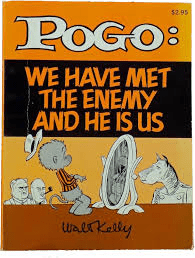
Own worst enemy: to be the source of one’s difficulties.
Ancient philosophers already had this one out in circulation with the idea that “What is man’s chief enemy? Each is his own” (Anacharsis 550 B.C.). Although the cartoonist summed it up better with Pogo stating, “We have met the enemy, and they is us.”
Oh my and oh my goodness, I left quite a few “O” clichés on the editing floor. If I left out a favorite I encourage you to browse through Christine Ammer’s Have a Nice Day–No Problem: A Dictionary of Clichés.
Next time it’s time to mind our Ps and Qs.



 Pam Webb
Several years ago when I had more time than now, I checked a book from the library on cliches. Now I am on a missions team of intercultural Ministries to recruit and minister to the various heritage groups possible. Love what I do.
cjsmissionaryministry@gmail.com
Hope you found a familiar cliche in the batch offered.
One bad apple spoils the whole bunch.
One man’s trash is another man’s treasure.
I may have already told you this, but when I taught 5th and 6th grades, I used to give students the beginning of familiar cliches and asked them to try and finish them. Some of their responses were unintentionally hilarious.
You can lead a horse to water, but . . .
Good picks. I wanted to include more but didn’t want to overwhelm my readers. Lead a horse to water but he might not want to go swimming?🐎
Well done, Pam. These were terrific!
Oh—thanks, Jennie!
You’re welcome.