Pam Webb

a writer's journey as a reader

Archive for the tag “everyday phrases”

How Cliché: Well Worn Literary Phrases


It is difficult to avoid clichés. I am hyper-sensitive to them, yet I still insert them verbally into my sentences (when writing I tend to be a bit more editorial and catch them before they make it to the final version). Do you catch yourself saying any of these ubiquitous clichés? Which ones are difficult to excise from your stable of sturdy go to phrases?
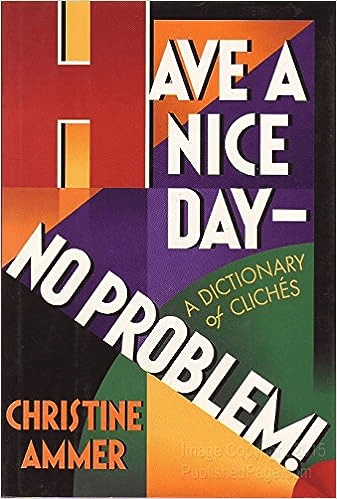
image: Amazon
a surprisingly fun read

Adding insult to injury: this one is covered more thoroughly in a previous post, but how else to best express that feeling of being doubly hurt? Keeper

Albatross Around Your Neck: credit Coleridge and his “Rime of the Ancient Mariner” poem in which a sailor has to wear the albatross he killed. Chicken-killing dogs were made to wear the dead bird around their neck to deter them from killing any further chickens–this must have been the strategy for Coleridge’s poor sailor. Talk about a fowl, unpleasant punishment! Associating dead, rotting birds around my neck with unpleasant tasks makes this a cliché unsavory. Avoid

Forever and a Day: Shakespeare is thought to have penned this phrase from Taming of the Shrew, yet it was found in earlier texts before the 1600s. Taking a long, long time isn’t as poetic as taking an eternity and then some, as in reference to those irritating traffic lights that seem endlessly red. I do use this one when the right occasion pops up. Keeper

Happily Ever After: a standard fairy tale ending that is credited to the fourteenth century Italian writer Giovanni Boccaccio. His stories usually ended with the phrase, “so they lived very lovingly, and happily, ever after.” This became shortened and when used today the speaker and listener is well aware of how cliché the phrase sounds. Avoid, though no harm, no foul

Little Did They Know: a phrase with tracings back into the nineteenth century and made popular by suspense writers in the thirties, forties, and fifties. Again, this one is easily identified as a cliché. No harm no foul

Not to Put Too Fine a Point on It: Charles Dickens is given credit for this one, which is derived from his novel Bleak House. Mr. Snagby liked to utter this phrase as a means of speaking plainly. Frankly I don’t use this one and don’t hear it much either. Moot

Pot Calling the Kettle Black: In Don Quixote there is a line where the frying pan insults the kettle, and since they are both made out of the standard black cast iron it is rather hypocritical for the frying pan to call out the pot being being relatively the same. I admit to using this one; however, do people know what a kettle is these days, let alone the obscure reference to black when there are so many choices in cooking ware available? Avoid, reluctantly (finding it tough to replace this one–calling out someone as a hypocrite is fairly blunt)

Well–how did you rate your own use of these clichés? Find some keepers, despite them being overused and eye roll worthy when mentioned? If they do slip out, no worries (which is becoming a cliché in its own right).
Why We Say: from Take the Cake to Turn Down


Moving into the T-section and there are some familiar sayings that have a surprising meaning. Ready?

First off–

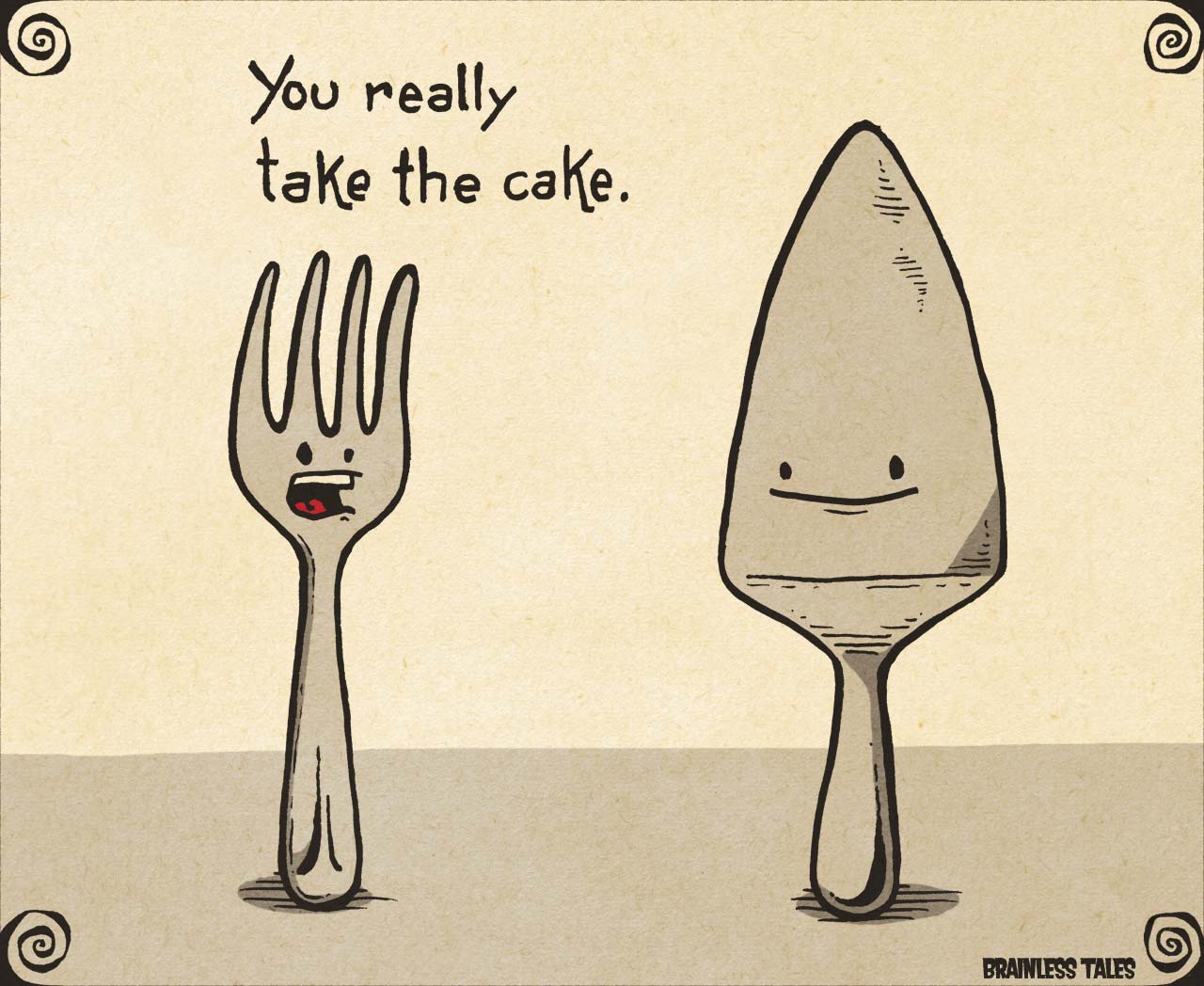
How many times have you heard the expression “Well, doesn’t that just take the cake?” as a response to something remarkable or perhaps foolish?

Take The Cake - Brainless Tales
Some have their cake and eat it, too.

Back in the day, in the South, when cakewalks accompanied barbeques, picnics, and box suppers, there was an event in which men showed off their style by “cutting a caper.” The one judged to do the best strutting received the prize of walking off with the choice of the best cake–and maybe the one who baked it.

Getting the third degree brings up connotations of being grilled severely by authorities, usually the police. The background on this term is derived from Freemasonry. A candidate looking to move up to the “third degree” had to pass a rigorous test. This testing process was supposedly so grueling, both physically and emotionally, that the “third degree” became associated with undergoing an arduous experience.

The Third Degree Techniques of Coerced Confessions, before 1930 - Coerced  Confessions CRJA 3400
Can I pass on passing this test?

After services are rendered it’s customary to provide a monetary gratuity, known as a “tip.” This practice stems from old English inns and taverns when patrons dropped a coin in the box attached to the wall for the servers. The sign on the box? “To Insure Promptness” or “T.I.P.” for short.

Amazon.com : BB INC Tip Box Acrylic Money Storage Container Tip Jar :  Office Products

Being called a “toady” is certainly no compliment, as it refers to a person being subservient to another, better known as being the “yes” man. The background on this term goes back to long ago magic acts that featured the magician’s apprentice or helper eating a, umm, ready for this–a toad. Why? Toads were considered poisonous. The magician then proved his magic by “curing” his assistant. Saying “yes” to eating a toad is probably not the best job in the world.

More 70 Toady to Synonyms. Similar words for Toady to.

Being loyal or devoted to a cause might conjure up the term “true blue.” Two possible meanings for the expression. One is from when butchers hid the bloody stains of their trade on their deep blue aprons and jackets. Perhaps the blue signified their pride in their chosen trade. The other derived meaning is that blue was the preferred color of the pro-Parliament Scottish Presbyterian Party of the seventeenth century as a contrast to the royal red. Hmm, the blue-red contrast has a deep history.

Sacred, Sad And Salacious: With Many Meanings, What Is True Blue? : NPR
True Blue can also be a purposed style choice

Few people relish being “turned down”–rejection is tough stuff. The expression has two possible explanations. One being the custom of turning over a drink glass when no more rounds are appreciated (messy if the glass is half full, or is that half empty?). The other explanation is another old custom. This one involves reflection upon rejection due to a mirror being the key to a marriage proposal. A young man would arrive with his “courting mirror,” which held his image. He would place it on the table face up to indicate he was proposing marriage. If accepted, the young lady would smile at the image and all was happiness. If she did not accept his proposal then she would turn the image face down and the “turn down” probably caused the young man to reflect upon his rejection.

What is a turn-down service? - English Language Learners Stack Exchange
Then there are other meanings of “turn down”

Post Navigation