Pam Webb

a writer's journey as a reader

Archive for the tag “everyday expressions”

How Cliché: Mmm


Make heads nor tails: failing to understand something. Cicero claimed this one, or a similar phrase, as denoting confusion, although he is attributed as saying, “Neither head nor feet.” Tails could refer to the other side of the coin, because before it is flipped and seen no one knows if it will be heads or tails lending itself to confusion as to the exact outcome of matters.

Photo by Pixabay on Pexels.com

Make no bones about it: no hesitation. An ancient saying that has different possibilities of meaning with one referring to how dice used to be made from bones and when someone threw them in a decisive manner.

March to the beat of a different drummer: to follow beliefs or a style diverging from the usual. A noted source is traced to Thoreau’s Walden: If a man does not keep pace with his companions, perhaps it sis because he hears a different drummer.” This idea of individualism was embraced by the 1960s era, especially, and has even been found in the business world where in a New Yorker article, Connie Bruck wrote, “We saw ourselves…as the tough guys, very smart, who were marching to our own drummer.”

Photo by absior u6c5fu6708 on Pexels.com

Mincing words: to speak plainly. Shakespeare used the phrase, “not to mince matters” in his plays, to mean “let’s moderate what is being said.” Over time “matters” became “words.”

Misery loves company: it’s easier to bear pain when shared with others. This idea hails back to ancient Greek and Roman times, and has traveled to modern times and has been broadened as Brian Moore suggests: “If misery loves company, then triumph demands audience.”

Monday-morning quarterback: someone who criticizes after the fact. This phrase is also known as “twenty-twenty hindsight.” When football became popular in the 1930s and mainly available on the weekends, it was not unusual for discussions to take place on Monday where “experts” would review the game, offering their “expertise” how the game should have gone. It now refers to someone who tends to second-guess decisions made.

Photo by Pixabay on Pexels.com

Moon made of green cheese: response indicating something is outlandish to consider. The idea is attached to how “green” the new moon appears in the night sky.

More than meets the eye: seeing only the top part or surface of something that has more depth. Going back to the nineteenth century in England when a fictional detective noted when viewing a dead body that “there is more here than meets the eye.” Today this cliché is pulled out to indicate that a matter needs to be looked at more carefully.

Mum’s the word: keeping something secret. Shakespeare once again. In Henry VI the line reads, “Seal up your lips, and give no words but–mum.” Mum means to keep silent and refers to the “mmm” sound the lips make when pressed together.

Photo by Monstera Production on Pexels.com

Mutual admiration society: shared feeling of regard between individuals. While it might have been a term of sincerity when first used, it is now considered sarcastic.

Mmmm, so many clichés got left on the editing floor. Which “M” phrases were you hoping to see?
How Cliché: “B” List part two


A collection of everyday sayings from Christine Ammer’s Have a Nice Day–No Problem: A Dictionary of Clichés.

Beggars can’t be choosers
If one is in need, being selective isn’t always an option, an adage which remains today. This expression of not being overly particular has two possible beginnings. John Heywood’s 1546 proverb collection is one, and Thomas fuller’s version (1732) “Beggars and Borrowers must be no Chusers” is another.

Behind the scenes
A term originating from seventeenth and eighteenth century theater where violent action took place behind the scenery. The idea of activity, especially secrets or hidden information taking place out of the public view, was summed up in the phrase of “behind the scenes.”

6,846 Behind The Scenes Stock Photos, Pictures & Royalty-Free Images -  iStock
What can’t be seen might be a scene not meant to be seen

Betting one’s bottom dollar
Being very certain of something is the general meaning. This mid-nineteenth century phrase refers to gambling, when a person referred to betting the last of their gambling chips, or the bottom of their stack.

The Big Cheese
The Boss. The Head Person. The origins are solid on this phrase. It’s thought to be nineteenth century American slang American. The word could be derived from the Persian or Urdu word chiz or cheez which means “thing.” It’s also thought it’s a derivation of the word “chief.”

The big cheese Royalty Free Vector Clip Art illustration  -cart0300-CoolCLIPS.com
The Big Cheese: what rates as the chosen cheese?

Bite the bullet
Facing a painful situation might have come from those wounded in battle who had to face treatment without anesthesia and would bite down on a bullet to bear the pain. Rudyard Kipling has the line “Bite on the bullet, old man, and don’t let them think you’re afraid,” in his 1891 The Light That Failed. P.J. Wodehouse wrote the line in his 1923 The Inimitable Jeeves, “Brace up and bite the bullet. I’m afraid I have bad news.”

Bite the dust
To become defeated, even to one’s death conjures visions of old Western films where either the cowboys or the Indians fell in the fight to the dusty ground. In actuality this phrase has much earlier roots, as it is found in Homer’s Iliad, “…his fellow warriors…fall round him to the earth and bite the dust.”

Black sheep
To be a sheep culled out of the flock due to having wool that could not be dyed became an application for people. Sir Walter Scott wrote in 1816, “The curates know best the black sheep of the flock.” This later became known as “the black sheep of the family” referring to that one family member who stood out as an undesirable or had unacceptable characteristics.

The Black Sheep Gospel | Toko-pa's Official Website
“Just another baaaad label”

Blood is thicker than water
Family relationships being considered more valued than other bonds comes from the Middle Ages application that water will evaporate, becoming invisible, with no trace of existence; however, blood, even when dried leaves its mark, implying how blood ties are essential is still relevant today.

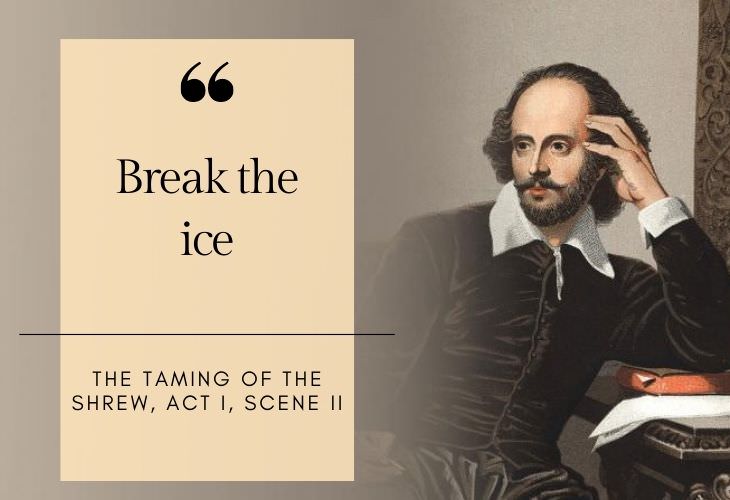
Break the ice
Originally this referred to how it was necessary to break up the ice so ships could sail through the water. Special vessels called “icebreakers” cleared away the ice and by the sixteenth century this term became more figurative than literal. Shakespeare applied this phrase, among other authors.

10 Common Phrases We Should Thank Shakespeare For
Kate broke more than ice in this farcical play

Business as usual
Carrying on, even when circumstances are difficult might have come from the practice of businesses posting a notice that stated that they would continue operating despite circumstances such as fire, flood, construction or other situations that might indicate not being available. Winston Churchill applied this idea in his November 1914 speech when he stated “The maxim of the British people ‘Business as usual,” which became a slogan for World War I.

Projects vs. BAU(Business as Usual) – Nic
Carry On, It’s Business as Usual

By the book
To strictly follow the rules is thought to originate from established criteria, as found in religious applications. This idea could be found in literature such as Edgar Allan Poe’s 1841 The Murders in the Rue Morgue, “To have a retentive memory, and to proceed ‘by the book,” as a reference to the game whist.

By the same token
In the fifteenth century into the 1600s a “token” was a sign or symbol and “by the same token” had the meaning of “for the same reason” or “on the same grounds.” After 1600 “by the same token” referred to “the proof of this being…”, leading Charles Dickens to write in 1857, “Others caused large Fires to be made…; by the same token that two or three were please d to set their house on Fire…”

What sayings surprised you in their origin?


Why We Say: E batch


This month’s Why We Say is a batch fresh from the “E” section.

Eavesdropper

Going back to the Saxon days of England, a person could not build right to the property line since it was mandated that there needed to be space for the drip that rolled off the eaves. This became the “eavesdrip” and someone who leaned near the eavesdrip could hear what was being said in the next house, making them an “eavesdropper.” Maybe this is where the expression of being a “drip” originates from.

Electricity

What does amber have to do with electricity? Dr. William Gilbert, who was Queen Elizabeth I’s physician in 1601, decided to call the effect he produced when rubbing amber with a cloth “electric,” which comes from elecktron, Greek for amber. What this has to do with QEI, I’m not sure–it might be too shocking to conjecture.

Etiquette

Should you find yourself time traveling back to the royal court of France, you might be handed a card of instructions informing you how to behave. This card or ticket or estiquet eventually became “etiquette” or the rules of social behavior. So does one receive a ticket from the polite police if one does not follow the rules posted on the estiquet?

Bonus!

At no extra charge are a few specials from the F” chapter:

Farce

The Latin farcire means “to stuff” and the early religious plays often were stuffed with jokes and comedic scenes which led to humor that was obvious which came to be known as a “farce.”

Going Through Fire and Water

In early times people often had to prove themselves, usually their innocence, by going through some sort of trial. An example of going through fire was having to walk barefoot across hot coals or carrying a red-hot bar. A water test might involve sticking a hand in boiling water. Today, going through extremes, might feel like an endurance test of fire and water.

Fit as a Fiddle

Actually, this should be “fit as a fiddler.” Yeah, playing for a dance all night would take a bit of stamina.

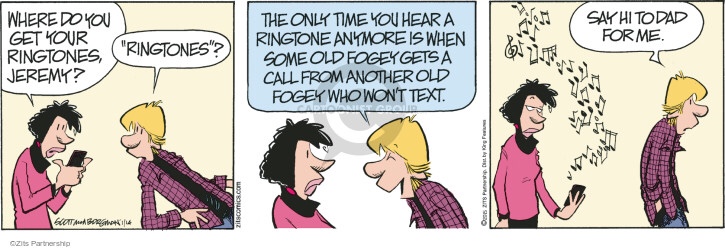
(Old) Fogey

At one time the English word “foggy” meant “fat” or “moss-grown.” The Scotch transferred “foggy” into “fogey” to mean disrespect towards an old man who did not keep up with the times. I suppose moss can grow on a person who doesn’t keep up with change fast enough.

Need more fantabulous “F” sayings? Come back next month. I’ll even throw in some “G” selections.

DOWO: The “C” List


Onward we travel into the Dictionary of Word Origins, adventuring in the land of “C.”

What is the phrase “carte blanche” all about?

It once was the custom for officials, or personage of importance, to provide a trusted subordinate with blank paper with their signature. These signed documents could then be used as necessary. “White paper” doesn’t quite sound as impressive as the French translation carte blanche. “Just sign here,” takes on another meaning.


Why is the feline in Alice in Wonderland known as a Cheshire cat?

Alice probably didn’t realize that the cat she came to know in her dreamy adventure was sporting a grin that emulated the cheeses sold in the Irish Cheshire Country. These cheeses were molded to look like cats with very wide grins. Hmm, think there is a connection between Cheshire cats and why we say “cheese” tight before our picture is taken?

Image: pngmart.com

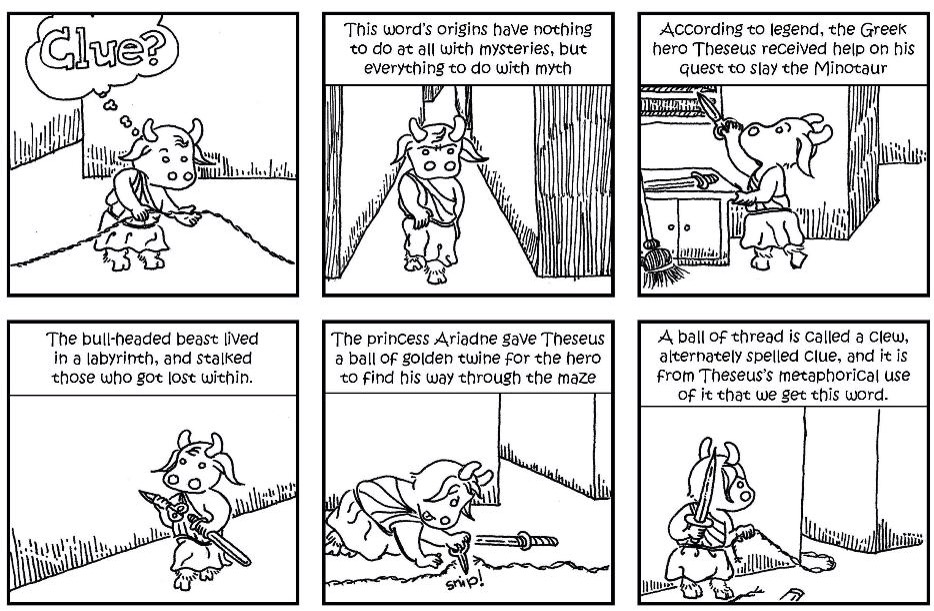
Why is something that is a hint called a “clue?”

In middle English a ball of thread was known as a “clew” or “clue” and when applied to the story of Theseus, the way out of the maze was how he followed an unrolled ball of thread. Hint, hint the thread of logic is quite clear here in this story of how he unraveled his escape plan. Then again, what if the Minotaur was smarter?

babblecomics.blogspot.com

How is a disappointed person “crestfallen?”

Roosters carry into a fight their bright red coxcomb or crests upright, signaling their readiness and awareness The losing rooster runs from the fight with a drooping crest. Not having seen a rooster fight (or having a desire to do so) I remain a wee bit skeptical on this one.

wordsdontfailme.tumblr.com

What is meant to “curry favor?”

In Middle English “horse ” is  favel, and to “curry” a horse is to groom it with a special comb. The results are usually a sleek looking horse. The idea here is for someone who hopes to makes a impression will do something noticeable like a groom hoping to catch his master’s attention might curry the favel. Sometimes the attempt is quite obvious.

johnhartstudio.com

The Challenge: Can you create a sentence with the above sayings? Give it a try…Or at least one saying:

Post Navigation