Pam Webb

a writer's journey as a reader

Archive for the tag “Dictionary of Word Origins”

DOWO: The “C” List


Onward we travel into the Dictionary of Word Origins, adventuring in the land of “C.”

What is the phrase “carte blanche” all about?

It once was the custom for officials, or personage of importance, to provide a trusted subordinate with blank paper with their signature. These signed documents could then be used as necessary. “White paper” doesn’t quite sound as impressive as the French translation carte blanche. “Just sign here,” takes on another meaning.


Why is the feline in Alice in Wonderland known as a Cheshire cat?

Alice probably didn’t realize that the cat she came to know in her dreamy adventure was sporting a grin that emulated the cheeses sold in the Irish Cheshire Country. These cheeses were molded to look like cats with very wide grins. Hmm, think there is a connection between Cheshire cats and why we say “cheese” tight before our picture is taken?

Image: pngmart.com

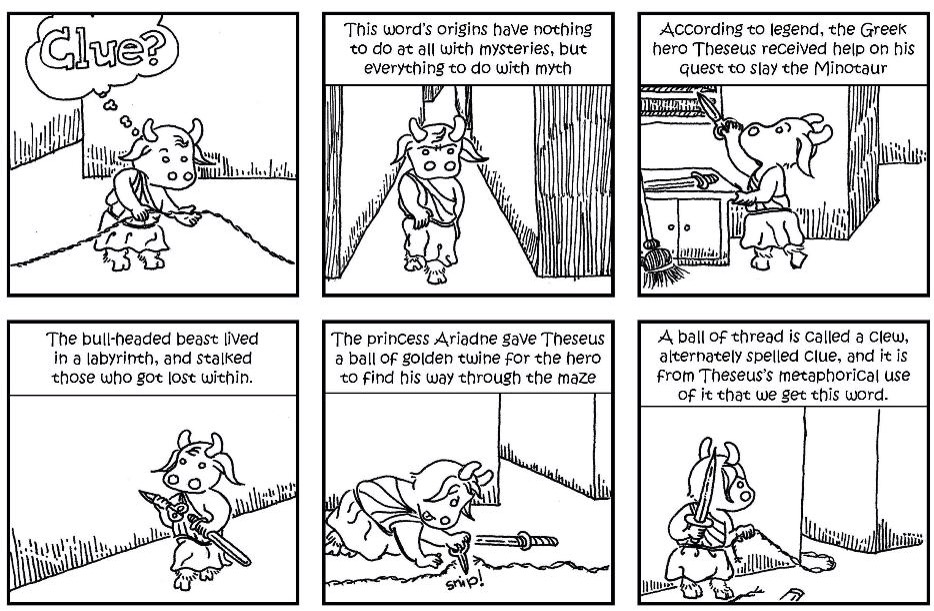
Why is something that is a hint called a “clue?”

In middle English a ball of thread was known as a “clew” or “clue” and when applied to the story of Theseus, the way out of the maze was how he followed an unrolled ball of thread. Hint, hint the thread of logic is quite clear here in this story of how he unraveled his escape plan. Then again, what if the Minotaur was smarter?
babblecomics.blogspot.com

How is a disappointed person “crestfallen?”

Roosters carry into a fight their bright red coxcomb or crests upright, signaling their readiness and awareness The losing rooster runs from the fight with a drooping crest. Not having seen a rooster fight (or having a desire to do so) I remain a wee bit skeptical on this one.

wordsdontfailme.tumblr.com

What is meant to “curry favor?”

In Middle English “horse ” is  favel, and to “curry” a horse is to groom it with a special comb. The results are usually a sleek looking horse. The idea here is for someone who hopes to makes a impression will do something noticeable like a groom hoping to catch his master’s attention might curry the favel. Sometimes the attempt is quite obvious.

johnhartstudio.com

The Challenge: Can you create a sentence with the above sayings? Give it a try…Or at least one saying:


DOWOs: the “B” list


If new to DOWO, it stands for Dictionary of Word Origins by Jordan Almond, which is a new source for exploring all those words, expressions, idioms, and clichés that abound in our language having thoroughly explored our previous source Why We Say.

If you were here last month around the fifteenth, you know we have already covered the “A” list. We are now off exploring the “B” list:

Why is the four year degree called a “bachelor’s” degree?

Originally a bachelor was a soldier, a man neither old enough or wealthy enough to lead into battle under his own banner, and was considered to be inferior in status. When colleges became more popular, to distinguish between the levels of study and awarded degrees, “bachelor” was the indicated inferior to that of “doctor.”

No mention of how “master” came to be, and it is of note that a “master” is lower than a”doctor” designation, yet “master” does carry more significance than a “mister” status.

How did “taking the back seat” come to mean taking a lesser position?

British Parliment dictates that those members of the majority part take the front seats while those in minority are relegated to the back, or are told to do so. In case you are wondering if it is “back seat” or “backseat” here is the discussion:

Where did the term “bankrupt”come from?

In Italy money-changers placed money available to loan on a banca or bench. If unable to continue in business, the bench would be broken or banca  rotta. The broken bench became synonymous with the broken money lender and both were banca rotta or “bankrupt.”

What is a “bare-face lie?”


To tell a lie without having show your face is much easier than having to face someone and tell a lie, as in trying to keep a straight face while communicating a big fat fib.

Why is an airship called a “blimp?”

It was almost called “A-limp.” In 1914 England began testing airships, and of the two designs the “B-limp” rose to usage. Why “limp?” It was non-rigid–but you guessed that right?

What is meant by “once in a blue moon?”


Blue moons supposedly never happen, which was the original saying. However, moons can appear blue when seen through volcanic explosion ash, so maybe, just maybe a blue can be seen–but just barely. They are fairly rare and their appearance may only happen once in a person’s lifetime.

Why does a person “bone up” for exams?

The Bohn publishing printed up study aids for students which were referred to as a “Bohn up” later becoming a “bone up” as a play on “bonehead” meaning a person who wasn’t smart (because you must have a thick skull and no brains if you need extra help studying).

What is meant by “getting down to brass tacks?”

In early England draper shops the draper placed brass tacks along the counter to aid in measuring off material. When a customer was ready to purchase cloth the draper would get the desired stock down to the brass tacks to measure off and complete the transaction.

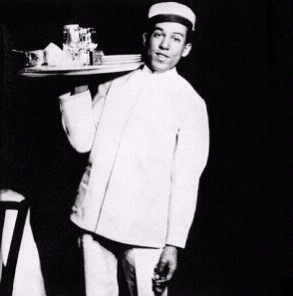
Where did the term “bus boy” come from?


The Latin term omnibus means “for all.” An “omnibus boy” was a lad who did a bit of everything, and it became shortened to “bus boy.”

Which saying totally made your day, tweaked your paradigm, or prompted you to immediately want to run out and share with someone?

Post Navigation