Pam Webb

a writer's journey as a reader

Archive for the category “Writing”

Updated Momisms


Mother’s Day has taken on new meaning having become an Empty Nester. The kiddos have flown the coop, starting their own lives, and while I’m still, and will always be their Mum, I don’t expect or need a big flautin’ tootin’ acknowledgement of being their mother.  Thanks, but not needed, Hallmark.  Another calendar guilt day.  Whoa–wait–stop–I didn’t mean to go in this quasi-negative direction. Of course, getting a card or phone call or even flowers is sweet and appreciated, but everyday I’m reminded that it is so cool I’m a mom of three very lovely children who have become adult just that fast. The youngest turned 21 in March and the oldest will be turning the *yikes* 29 in June.  How’d that happen?  Wasn’t it moments ago I was telling them:

  • Hey! I’m your mother not the maid. Pick up your stuff!
  • Don’t make me come back there!
  • Just try one bite–
  • It’s your brother’s turn to pick the movie.
  • No, I don’t have money for candy.
  • You can have one–I said one.
  • Not before dinner.

Now that they are adults, I find the following conversationals happening:

  • How’s work going?
  • Is this a “friend” or a friend?
  • Do you need gas money?
  • What are you doing for the holidays?
  • Is it okay if Pops and I come over?
  • Do you want to meet at the restaurant?

Yes, I notice they tend to be questions rather than statements?  Why is that? Maybe it’s because I can’t really tell my kids to get a haircut, or that they should tidy up their apartment anymore.  But I guess I do. *Sigh* I really can’t stop being a mother so easily.  There is not switch off once the kinder become A-dults.  That Mom drive just keeps going.

So, this post is dedicated to my children.  You make Mother’s Day happen everyday–not only some designated May Sunday.

And this is why I wrote that essay that got in Chicken Soup for the Soul: The Multitasking Mom’s Survival Guide. 

Now that you have all moved out and have your own lives I finally do have “A Little Piece of Quiet.”

Loves and Hugs, Mum

Chicken Soup Cover

Image: Amazon Inspiration: My Very Own Progeny (psst…story #10)


A Bouquet of Books


Though I reveled in the reading of much poetry during April, I did, of course, squeeze in time to read some books.  April proved to be an eclectic assortment of reading.  I liken my selections to ambling in the fields and randomly selecting whatever bloom which appealed to me.  I do that at times when browsing through the library. I pick up a book for its cover art. Another for its title. That one because of the author. And this because of the genre. I usually end up with more books than I have time for and those pesky reminders to either return or renew my selections perch in my email basket.

Here’s my batch of April reads, although I notice it’s a bit of a redundancy now that GoodReads is posting more complete reviews when posting our updates.

1. Lady Susan by Jane Austen.
One of the progeny thoughtfully gave me a handsome collection of Jane Austen’s works, and surprise! I was not aware of Lady Susan, an epistolary novel, signifying a buttercream in life’s box of chocolates. Yum!

Not your usual Austen heroine by any means. Lady Susan is attractive yet conniving with loose moral standards. She is rather quite naughty, actually. Recently widowed Susan manages to wheedle a long term visit with her in-laws and it is through letters readers discover Lady Susan’s plot to marry the much younger Reginald while arranging a match for her daughter, whom she openly disregards. Epistolary novels are not easy reads, due to the lack of plot continuity, but halfway in I definitely remained intrigued.  We’ll see how Hollywood manages this one some day.

2. Critical Condition by Richard L. Mabry
Reviewing for BookLooks means trying out new authors and the latest reads in Christian publication, and it has proved a good fit for my reading schedule. This latest pick was an author I’m unfamiliar with and being drawn to faith-based murder mysteries, I gave it try.  I know, faith-based murder mystery sounds like an oxymoron, yet it’s a genre that means I enjoy a novel of suspense without the worry of undue gore, bedding, and swearing.  I just want to kick back and figure out who dunnit.

While I appreciated the plot, I was often annoyed with the writing style of multiple points-of-view and extraneous plot turns.  I might try out another of his books, just as a matter of being open-minded.


3. Understanding Great Literature: Romeo and Juliet by Thomas Thrasher.
Although I’ve been teaching R&J for over ten years, I am always looking for a new way to understand this timeless play, especially since it is usually the first introduction to Shakespeare for students. I am always attracted to quick reads with depth and Thrasher fills the bill with this entry in the Understanding Great Literature collection. An unexpected bonus was the Shakespeare bio and timeline.

4. A Reader’s Book of Days: True Tales from the Lives and Works of Writers for Every Day of the Year by Tom Nissley.
This would make a great desktop calendar because in book form I quickly lost interest beyond skimming beyond random days. Otherwise, Nissley provides an entertaining and informative tome containing odd and interesting bits about writers. And that in itself makes it a worthwhile read.


5. Contrary to Popular Belief: More than 250 False Facts Revealed by Joey Green
This is more or less an abridged Snopes.com. Fun factoids are always fascinating. A dipper for those moments when crunching a quick breakfast bite, or needing a quick pop of reading before bedtime.

6. The Help by Kathryn Stockett
Having watched the movie I deemed it time to read the book.  I did indeed enjoy my weekend curling up time with this one.

7. Captives and Outcasts by Jill Williamson
These were also BookLook review books. I read Captives earlier in the year and pounced on Outcasts when I saw it. I do like to read series books as consecutively as possible. This is a dystopia series that touches on some mature themes, even for the Christian market. What would the future be like if society gave in living for the moment knowing they could die any time? The plotline is intriguing enough to get me past the author’s penchant for multi-view presentation.

image: amazon.com


I hope to squeeze in more reading in the midst of grading AP essays.  There are days when nothing but a book can clear the mind of screen fuzz.  Anyone else out there find themselves avoiding the computer or even their iDevices due to screen overload?  This is why I cannot possibly see books ever going out of print.  Slipping a page, that paper to brain connection puts my head back in place, ever so nicely.


Adieu, Adieu Sweet Month of Muse


national-poetry-month

I agree with Juliet, “Parting is such sweet sorrow.” April is a busy, busy month with its heralding of spring, removal of snow tires, paying of taxes, celebrating Billy Bard’s birthday, prepping for AP exams, and musing upon poems. I started loading my April blog calendar back in December as I discovered poems and poets I would pre-schedule them and now the days are spent and I am a bit bereft as I head into May. Whatever shall I fill my May days with?  It is ever so nice to have a theme for a month, like poetry for April. May will probably become my mish-mash month. I have several posties that I’ve been saving that don’t relate to anything except that I like them–sorta serendipity finds.

As I bid adieu to April I shall reflect:

  • Gathering poets for most of the year is akin to Saturday yard sale mornings as I scout for treasures to stuff in my bag
  • I appreciate poetry more and more as I become more and more involved with the reading of it
  • Having Billy Bard’s 450th birthday in the middle of National Poetry Month was absolute icing on the loveliest of cakes
  • Passing out poems to my students on April 24 for National Poem in Your Pocket Day is a blast–reactions range from excited anticipation of reading their poem to leaving them on the floor–which is about par for poetry (love it or leave it)
  • My school superintendent emailed me that I encouraged him to read a sonnet in my postscript to enjoy Shakespeare’s birthday
  • I decorated my hallway in recognition of Shakespeare’s birthday and convinced the journalism department to put it in the school’s daily video. Well, it’s not everyday a person is 450 years old…


Displaying photo.JPG


I look forward to May. School is winding down, weather is heating up, and the countdown to summer break begins.  Here is to May and all its blooming good days

24112-teacher_at_desk

Waiting out the days of May to slip into June

Poetry Workshop: Sestina


I thought there has been enough recovery time since the last workshop, which focused on the villanelle.  So, let’s move on to the sestina.


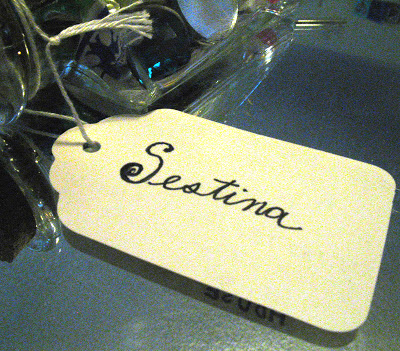
The image above intimates that the sestina can be neatly labeled.  Hmm, perhaps not.  Below is a famous example by Elizabeth Bishop.  I do like her work, if I haven’t mentioned that before.  This offering is simply called, “Sestina.”

September rain falls on the house.
In the failing light, the old grandmother
sits in the kitchen with the child
beside the Little Marvel Stove,
reading the jokes from the almanac,
laughing and talking to hide her tears.

She thinks that her equinoctial tears
and the rain that beats on the roof of the house
were both foretold by the almanac,
but only known to a grandmother.
The iron kettle sings on the stove.
She cuts some bread and says to the child,

It’s time for tea now; but the child
is watching the teakettle’s small hard tears
dance like mad on the hot black stove,
the way the rain must dance on the house.
Tidying up, the old grandmother
hangs up the clever almanac

on its string. Birdlike, the almanac
hovers half open above the child,
hovers above the old grandmother
and her teacup full of dark brown tears.
She shivers and says she thinks the house
feels chilly, and puts more wood in the stove.

It was to be, says the Marvel Stove.
I know what I know, says the almanac.
With crayons the child draws a rigid house
and a winding pathway. Then the child
puts in a man with buttons like tears
and shows it proudly to the grandmother.

But secretly, while the grandmother
busies herself about the stove,
the little moons fall down like tears
from between the pages of the almanac
into the flower bed the child
has carefully placed in the front of the house.

Time to plant tears, says the almanac.
The grandmother sings to the marvelous stove
and the child draws another inscrutable house

Anything standout? Anything noticeable?  Yes, there are repeating words. Six of them. Nicely done. Sestina–six: yup, there is a definite connection.

A sestina according to the Bing dictionary:

  1. Definition of sestina (n)

    Bing Dictionary
    • ses·ti·na
    • [ se stéenə ]
    1. form of poem: a poem of six six-line stanzas and a three-line envoy or, with the last words of the first six lines repeated, in different order, at the ends of the other lines

Using Bishop’s model, let’s explore how that really works.

Oh, by the way–if you are one of those who groove on numbers more than poetry, you will really like sestinas, because it’s all about patterns.

Okay. Here we go:

The structure of a sestina, in this case, Bishop’s “Sestina,” is six stanzas of six lines with a three line envoy (the conclusion of the literary work). The pattern is: 123456; 615243; 364125; 532614; 451362; 246531 with the envoy as 531 or 135.  Return to the poem and decide which six words repeat throughout the poem.

If you really want to see how a sestina works without all the extra word wading go check out “Six Words” by Lloyd Schwartz. Very, very clever.


Well, that wraps up another National Poetry Month. Thanks for stopping by. I hope you learned a bit along the way, and appreciated new-to-you poets and their poetry.


Poet Appreciation #10: Abraham Lincoln


We associate Abraham Lincoln with the Civil War, tall silk hats, a famous speech, a humble man with a distinctive beard, a day off in February, and the sadness that comes when great people are struck down too soon. Connecting our sixteenth president to poetry doesn’t usually pop up in the usual sixty-second classroom brainstorm activity.  And yet, here is proof Honest Abe had so much more to him than we give him credit for.

image: history.com

My Childhood Home I See Again
by Abraham Lincoln

My childhood home I see again,

And sadden with the view;

And still, as memory crowds my brain,

There’s pleasure in it too.

O Memory! thou midway world

‘Twixt earth and paradise,

Where things decayed and loved ones lost

In dreamy shadows rise, 


And, freed from all that’s earthly vile, 

Seem hallowed, pure, and bright, 

Like scenes in some enchanted isle 

All bathed in liquid light. 


As dusky mountains please the eye 

When twilight chases day; 

As bugle-notes that, passing by, 

In distance die away; 


As leaving some grand waterfall, 

We, lingering, list its roar– 

So memory will hallow all 

We’ve known, but know no more. 


Near twenty years have passed away 

Since here I bid farewell 

To woods and fields, and scenes of play, 

And playmates loved so well. 


Where many were, but few remain 

Of old familiar things; 

But seeing them, to mind again 

The lost and absent brings. 


The friends I left that parting day, 

How changed, as time has sped! 

Young childhood grown, strong manhood gray, 

And half of all are dead. 


I hear the loved survivors tell 

How nought from death could save, 

Poem in Your Pocket?


Yes!

Pick a poem

from the offered bouquet

carry the fragrance

of words which refresh

and delight

Place a poem in your pocket

and travel

to new lands

make new friends

discover old memories

enliven the senses

and then

share it

Poet Appreciation #8: William Shakespeare


*Gasp* Billy Bard is celebrating his 450th birthday on the 23rd. I advise those attending the birthday party to stick to the crumpets and steer clear of the kippers, as they didn’t do ol’ William any good at his own birthday din celeb.

Would William be surprised to know how many Bardinators there are coasting about due to his most marvelous ability with words, wit, and retrofitting old tales into something more appealing?  Probably.  Ben Jonson knew his contemporary, and somewhat rival was “a man for all time.”

What better way to say “Happy Birthday, Bill!” than with a couple of his sonnets.

First, the Mona Lisa of his career:

SONNET 18

Shall I compare thee to a summer’s day? 
Thou art more lovely and more temperate:
Rough winds do shake the darling buds of May,
And summer’s lease hath all too short a date: 
Sometime too hot the eye of heaven shines,
And often is his gold complexion dimm’d; 
And every fair from fair sometime declines,
By chance, or nature’s changing course, untrimm’d;
But thy eternal summer shall not fade
Nor lose possession of that fair thou ow’st;
Nor shall Death brag thou wander’st in his shade,
When in eternal lines to time thou grow’st; 
So long as men can breathe or eyes can see,
So long lives this, and this gives life to thee


Who hasn’t heard this lovely tribute of admiration? No matter how many years I’ve taught it to high school students they still “get it” and appreciate the trick ending of the couplet.  That’s what I like about Wm’s wit: it’s subtle and winking.  I think he’s winking right now as it’s being read. I’ll let Michael York recite it for you.  He gets it for sure, this is a loving tribute (don’t get shook up about it being for a man, like my freshmen do–this was supposedly to William S.’s patron, the guy who paid the bills so Wm could keep writing. Is that any different from dedicating a song or book to an agent, sibling, parent, or editor?)

Another tribute sonnet is perhaps not as complimentary, yet I think it showcases Shakespeare’s ability to take the accepted medium and poke fun at how poets tended to extol too vigorously the glories of a person, thus rendering him or her to be removed from humanity–it’s difficult to climb down off a pedestal that’s built too high. This particular sonnet at first sounds like a bash session; however, after a step back moment, it’s clear to see Shakespeare extols the real beauty of his love.  He loves this woman, warts–that is, frizzy hair, and all.

SONNET 130

My mistress’ eyes are nothing like the sun;
Coral is far more red than her lips’ red;
If snow be white, why then her breasts are dun;
If hairs be wires, black wires grow on her head.
I have seen roses damask’d, red and white,
But no such roses see I in her cheeks; 
And in some perfumes is there more delight
Than in the breath that from my mistress reeks.
I love to hear her speak, yet well I know
That music hath a far more pleasing sound;
I grant I never saw a goddess go;
My mistress, when she walks, treads on the ground:
   And yet, by heaven, I think my love as rare
   As any she belied with false compare.

This video captures the satire of those mushy sonnets while intones the general attitude of love.  Alan Rickman and typography mash up at its best.  Wouldn’t you want Alan Rickman reciting a sonnet to you?  Check yes.


These are only a drop in the sonnet bucket.  Wills wrote 150 sonnets, far more than the 38 plays we know to be roaming about.  So why do we mostly associate him with being a playwright than a poet?  According to many historical sources, he considered himself to be more of a poet than a playwriter. Hmm, it’s easier to turn a play into a film than a sonnet, I suppose.

Once again, Happy Birthday, William!

image: facebook.com


Poet Appreciation #6: Eliza Lee Follen


While it’s grand to dig away at meaning, symbolism, and theme, it can refreshing to simply enjoy a poem for its bouncy rhythm and rhyme and wit.  This is the case for Eliza Lee Follen’s “Lines on Nonsense.”

Edward Lear renders an appropriate complement for today’s poem.

Lines on Nonsense

Yes, nonsense is a treasure!
I love it from my heart;
The only earthly pleasure
That never will depart.

But, as for stupid reason,
That stalking, ten-foot rule,
She’s always out of season,
A tedious, testy fool.

She’s like a walking steeple,
With a clock for face and eyes,
Still bawling to all people,
Time bids us to be wise.

While nonsense on the spire
A weathercock you’ll find,
Than reason soaring higher,
And changing with the wind.

The clock too oft deceives,
Says what it cannot prove;
While every one believes
The vane that turns above.

Reason oft speaks unbidden,
And chides us to our face;
For which she should be chidden,
And taught to know her place.

While nonsense smiles and chatters,
And says such charming things,
Like youthful hope she flatters;
And like a syren sings.

Her charm’s from fancy borrowed,
For she is fancy’s pet;
Her name is on her forehead,
In rainbow colors set.

Then, nonsense let us cherish,
Far, far from reason’s light;
Lest in her light she perish,
And vanish from our sight.

Eliza Lee Follen (1787-1860), was ten in a family of thirteen children. Born into an affluent Boston family she became a poet, children’s author, editor, and abolitionist. Her children’s verse offerings posed light and nonsensical images in contrast to the more serious ones of her time. She and her husband, Charles Follen had one son.

Last Call for YA Writer Hopefuls…


Tomorrow is the deadline for the Writer’s Digest 15th Free Lucky Agent Contest.

Free definitely caught my attention.  The fact that the contest is focusing on Young Adult helped motivate me to enter.  Who could resist the prize:

Three  winners  will be awarded the following:

1) A critique of the first 10 double-spaced pages of their work, by the agent judge

2) A free one-year subscription to WritersMarket.com

The critique will be given by agent  Andrea Somberg, a literary agent who represents various fiction and non-fiction projects including those aimed at young adult and middle grade audiences.

I selected one of my YA manuscripts, spent some time polishing it, and submitted it.  It’s not too late! If you are a YA writer  go to this link for my details.

  Hoping to have good news about my submission.


Now–back to poetry and National Poetry Month.

Poetry Workshop: The Villanelle


The villanelle is one of those poem forms that when rendered well looks so effortless it’s surprising to learn how difficult they really are to write.


What is a villanelle?

This is a rather strenuous poem in that it contains nineteen lines, which amounts to five stanzas of three lines and one stanza of four lines containing four lines with two rhymes and two refrains.

Now if that isn’t complicated enough, keep this in mind: the first, and then the third lines alternate as the last lines of stanzas 2, 3, and 4, with stanza 5 ending in a couplet.  Oh, yes–the villanelle is usually written in a tetrameter, which is four feet or perhaps a pentameter, constituting of five feet

It’s best to see how a villanelle is wired together. If curious, or willing to try a villanelle with the example by Edward Arlington Robinson found at WikiHow

If you’re thinking, “Well, bosh and bother, I think I’ll pass on the villanelle,” I will leave you some well-known villanelles to contemplate.  Look for those repeating lines.  Like I mentioned earlier, a well-rendered villanelle won’t even appear to be trying so hard.  These poets make it seem rather effortless, don’t they?

Dylan Thomas’ “Do Not Go Gentle into That Good Night”  is one of the most famous villanelles. To demonstrate how the villanelle works the repetition is boldface and italics. A deeper discussion can be found at this link

Do not go gentle into that good night,
Old age should burn and rave at close of day;
Rage, rage against the dying of the light.

Though wise men at their end know dark is right,
Because their words had forked no lightning they
Do not go gentle into that good night,

Good men, the last wave by, crying how bright
Their frail deeds might have danced in a green bay,
Rage, rage against the dying of the light.

Wild men who caught and sang the sun in flight,
And learn, too late, they grieved it on its way,
Do not go gentle into that good night,

Grave men, near death, who see with blinding sight
Blind eyes could blaze like meteors and be gay,
Rage, rage against the dying of the light.

And you, my father, there on the sad height,
Curse, bless, me now with your fierce tears, I pray.
Do not go gentle into that good night,
Rage, rage against the dying of the light.


Another villanelle example:

When I saw you last, Rose,
You were only so high;—
How fast the time goes!

Like a bud ere it blows,
You just peeped at the sky,
When I saw you last, Rose!

Now your petals unclose,
Now your May-time is nigh;—
How fast the time goes!

And a life,—how it grows!
You were scarcely so shy
When I saw you last, Rose!

In your bosom it shows
There’s a guest on the sly;
How fast the time goes!

Is it Cupid? Who knows!
Yet you used not to sigh,
When I saw you last, Rose;—
How fast the time goes!

                            –Austin Dobson

You probably found those repeating lines all on your own, didn’t you?

Here’s a more contemporary villanelle.  Do check out more of Elizabeth Bishop’s poetry. She’s amazing.

One Art
Elizabeth Bishop (1911-1979)

The art of losing isn’t hard to master;
 so many things seem filled with the intent
to be lost that their loss is no disaster.Lose something every day. Accept the fluster
of lost door keys, the hour badly spent.
The art of losing isn’t hard to master.Then practice losing farther, losing faster:
places, and names, and where it was you meant
to travel. None of these will bring disaster.

I lost my mother’s watch. And look! my last, or
next-to-last, of three loved houses went.
The art of losing isn’t hard to master.

I lost two cities, lovely ones. And, vaster,
some realms I owned, two rivers, a continent.
I miss them, but it wasn’t a disaster.

–Even losing you (the joking voice, a gesture
I love) I shan’t have lied. It’s evident
the art of losing’s not too hard to master
though it may look like (Write it!) like disaster

If you haven’t filled up on villanelles yet, I suggest clicking here and reading on a rather nice collection.

Thanks for stopping in for the workshop.  I do hope you will give the villanelle a try, and even if you don’t, I hope you’ve gain an appreciation for a fascinating poem form.


Post Navigation